What Is Paper Trading in Crypto? The Complete Guide
Paper trading crypto means trading with virtual money on real, live market data. Prices move exactly as they do in the real market; only the balance is simulated. Nothing is deposited, nothing can be lost, and nothing leaves any account.
It exists so you can learn how a strategy behaves before a single real dollar is at stake.
The name is older than crypto. Traders once tested ideas by writing hypothetical positions on paper and tracking them by hand. The medium became software, but the logic held: rehearse with stakes that cannot hurt you.
In crypto, paper trading carries a second job that matters even more than practice. In a market crowded with scams and inflated claims, it is the most reliable way to see what a strategy actually does before you trust it with money or connect it to your exchange.
This guide covers how it works, how to do it properly, what it can and cannot tell you, and how to know when you are ready to go live.
How paper trading works
A paper trading setup has three moving parts, and understanding them is most of understanding the tool.
Live market data. Real prices from real exchanges, updating in real time. This is the detail that separates paper trading from a backtest. You are watching decisions play out against the live market as it happens, not against a recording of the past.
A virtual balance. You choose a demo amount, and the system tracks positions, profit, loss, and fees against it as though it were real money. The number is fake; the arithmetic is honest.
Real logic. Whether you are placing trades yourself or running an automated strategy, the same rules apply as they would live. Same entries, same exits, same position sizing. Only the money is simulated.
The result is a record that forms in front of you, day by day: when the strategy acts, when it waits, how deep its losing stretches run, and what its wins look like at realistic size. You are seeing behaviour, not a highlight reel.
One thing paper trading is not: a profit preview. Demo results are simulated and may differ from live results due to fees, slippage, and liquidity. A strategy that gained during a paper week is not promising you that gain live. What it shows you accurately is temperament: how often it trades, how patient it is, how it handles a dip.
Paper trading, demo accounts, and trading simulators: the same thing?
These labels get used interchangeably, and mostly that is fine, but the distinctions matter when you are evaluating a product.
Demo account and demo mode describe the same thing as paper trading: virtual money running on live market data. Forex brokers popularised the term, and crypto platforms borrowed it. If a platform offers a "demo account" on live prices, you are paper trading.
Trading simulator is looser. Some simulators run on live data, which makes them paper trading. Others replay historical data or generate synthetic prices, which makes them closer to a game. Before trusting a simulator's output, check which one it is.
Practice account and virtual portfolio are marketing terms for the same mechanic.
The label is not what matters. One question decides whether the tool is useful: is the price data live? If yes, you are testing against a market nobody has seen yet. If no, you are testing against a recording, and the result is far weaker evidence.
Paper trading vs backtesting vs live trading
These three get confused constantly, and the differences decide how much you can trust each one.
| Backtesting | Paper trading | Live trading | |
|---|---|---|---|
| Data | Historical (past) | Live (present) | Live (present) |
| Money | Simulated | Simulated | Real |
| Can be curve-fit? | Yes | No | No |
| Emotional reality | None | Low | Full |
| Best for | Designing a strategy | Verifying behaviour | The real thing |
Backtesting runs a strategy against historical data. It answers "how would this have performed in the past?" It is useful for design, and it is also the easiest thing in trading to make look good. Because the past is known, a backtest can be tuned until its results shine, a practice called curve fitting. A gorgeous backtest can be nearly meaningless.
Paper trading runs a strategy forward, on data nobody has seen yet. It cannot be curve-fit, because the future was unavailable when the strategy was built. This is why a forward paper run you watched yourself is stronger evidence than any backtest screenshot: it forms in real time, and nobody can polish it after the fact.
Live trading adds the final layer of reality: your own funds, real execution, real fees and slippage, and real emotion. Paper trading gets you most of the way, but not all of it, because knowing the money is fake changes how a loss feels.
A useful way to hold all three: backtesting is a rehearsal from memory, paper trading is a dress rehearsal on the real stage, and live trading is opening night.
Is paper trading crypto free?
It should be, and if it is not, that tells you something.
Paper trading uses virtual funds on live data. There is nothing to deposit, nothing at risk, and almost no cost to the operator beyond a data feed they already pay for. Free crypto paper trading is the normal state of the tool, not a promotion.
Two things to check on any product offering it:
Does it require payment first? A platform that charges before letting you observe a strategy has removed the entire point of the exercise. It is asking you to buy the evidence.
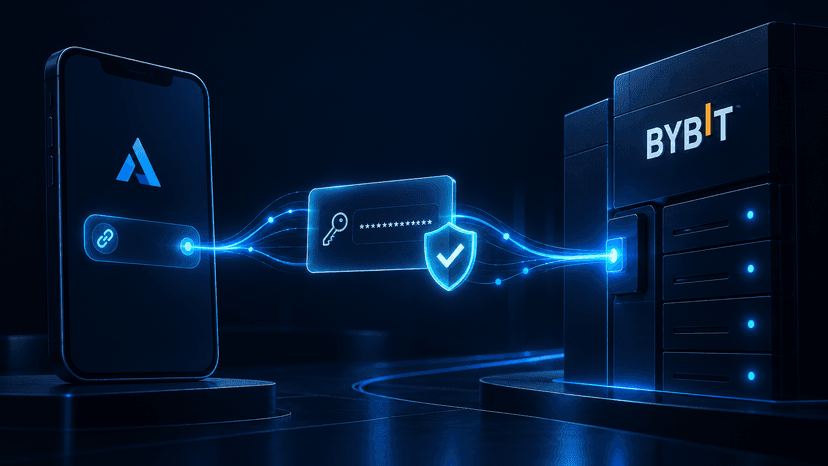
Does it require an exchange connection first? Genuine paper trading needs no API key and no exchange account. If a product asks you to connect before you can watch, the sequence is backwards.
Anything asking you to deposit real funds in order to "paper trade" is not paper trading, and that request is a warning sign in itself.
Why paper trading matters before you pay for anything
Most retail crypto traders arrive at a new product already wary, burned by signal channels or copy-trading losses. In that situation, the order of operations is everything.
The common order, and the one most products push: read the pitch, pay, connect your exchange, then discover how the strategy behaves. Every step asks for trust before offering evidence.
Paper trading lets you reverse that:
- Watch first. The strategy runs on paper, on live data, with demo money. No commitment, no risk, no card.
- Judge with your own eyes. Two weeks is usually enough to see quiet days, active days, and probably a drawdown: the full temperament rather than a highlight.
- Then decide about paying. The subscription question comes after evidence exists.
- Then, and only then, connect an exchange. Through a trade-only API key, so your funds stay on your own account.
At no point in that sequence are you asked to simply believe. Every claim gets tested before it costs anything.
This is also a fast scam filter, and worth stating directly. A product confident in its strategy can afford to let you watch it for free, because watching costs the operator almost nothing and proves almost everything. A product that needs your payment or deposit before it will show you anything has built its funnel around people who will be disappointed later. Regulators reinforce this from the other side: the US Commodity Futures Trading Commission warns that promises of guaranteed or unusually high returns from automated trading are a fraud marker. Paper trading is how you check a strategy's real behaviour against whatever it promised. We covered the other scam markers separately.
How to paper trade crypto, step by step
Whether you are testing your own decisions or evaluating an automated strategy, the method is the same.
1. Pick what you are testing
Decide the strategy or approach before you start. Testing "a bit of everything" teaches nothing, because you cannot attribute results to any specific logic. One strategy at a time.
2. Set a realistic demo balance
Choose a virtual balance close to what you would actually trade with. Someone who would deploy $1,000 learns little from practice crypto trading at $1 million, because position sizes, and the emotions attached to them, will not resemble reality. Realistic size makes the rehearsal honest.
3. Let it run long enough
The single most common mistake is stopping too early. A few hours or a single day tells you almost nothing. You want to observe the strategy across different market moods: calm stretches, volatile stretches, and ideally at least one drawdown. For most strategies that means around two weeks, and low-frequency strategies need the full window to trade enough to judge.
4. Watch the right things
Resist fixating on profit and loss in the first days. The informative signals are behavioural, and the next section covers them in full.
5. Keep a simple record
Note what the strategy did and, if you are trading manually, why you made each decision. Reviewing that record afterwards is where the actual learning happens. Patterns you would never notice in the moment become obvious on review.
6. Decide deliberately
At the end, ask a clear question: did this strategy behave in a way I understand and can tolerate? That, not the paper profit, is what tells you whether to go live.
What to watch during a paper trial
A paper run is only useful if you know what to look at. Profit and loss is the least informative number in the first two weeks. Watch these instead.
Trade frequency. Does it trade several times a day, or a few times a week? Does that match what you were told to expect? A mismatch between promised and observed activity is worth investigating.
Quiet periods. Good strategies wait for conditions rather than forcing trades. Days with no activity are normal, not a malfunction. If silence makes you anxious, far better to discover that on demo money than on real funds.
Drawdown behaviour. Every strategy has losing stretches. Watch how deep they run and whether they stay within the strategy's stated maximum drawdown. A strategy that respects its own risk limits during a bad week tells you more than one that got lucky in a good week.
Position sizing. Are individual trades sized sensibly against the balance, or is the strategy swinging large? Reckless sizing is visible in paper mode, before it can hurt you.
Your own reaction. This is the most underrated signal, and paper trading is the only place you can measure it safely. If a 5% paper drawdown makes you anxious, a high-risk strategy is wrong for you regardless of its numbers. Paper trading tests the trader as much as the strategy.
Two weeks of watching these tells you whether the strategy's temperament fits yours. That fit, more than any single result, is what makes automated or systematic trading sustainable.
The limits: what paper trading cannot tell you
An honest guide names the gaps, so here they are without softening.
Execution differences. Live orders face real slippage and liquidity that a simulation can only approximate. Live results are often somewhat worse than paper results, and the gap is widest for high-frequency strategies that depend on precise fills.
Emotional reality. Losing demo money does not hurt. Losing real money does, and that feeling pushes people into interrupting a strategy at the worst possible moment. Paper trading cannot fully close this gap. Knowing the gap exists is the preparation.
Future performance. Two strong paper weeks guarantee nothing about the next two live weeks. Past results, paper or live, do not predict future performance. Trading involves risk of loss, including loss of the funds you allocate.
Paper trading is the best available filter, not a crystal ball. It reliably screens out scams, mismatched risk levels, and strategies whose behaviour you could not live with. It does not promise profit, and any product presenting demo results as a profit forecast is misusing the tool.
Common paper trading mistakes
Even people who use paper trading often undercut it. The frequent errors:
- Stopping too early. A day or two cannot reveal a strategy's range. Give it the full window.
- Using an unrealistic balance. Practising with far more than you would really deploy distorts both sizing and emotion.
- Chasing paper profit. Treating the demo as a score to maximise, rather than behaviour to observe, teaches the wrong lesson.
- Ignoring your own reactions. The demo is your one chance to learn how you respond to a drawdown at zero cost. Waste it and you learn on real money.
- Switching strategies mid-run. Changing the thing you are testing halfway through means you have tested nothing cleanly.
- Treating good paper results as a promise. A profitable paper run is evidence of behaviour, not a forecast. Live conditions differ.
How to know you are ready to go live
There is no universal signal, but a few honest checks help.
You are likely ready when you can answer yes to all of these:
- I understand how this strategy behaves, including its quiet periods and its drawdowns.
- I watched it through at least one losing stretch and did not want to abandon it.
- Its maximum observed drawdown is something I could tolerate on real money.
- I am connecting through a trade-only API key, so my funds stay on my own exchange.
- I am starting with an amount I can afford to lose.
You are not ready if you are going live mainly because the paper results looked profitable, or because you feel impatient. Paper profit is not the qualification. Understanding and tolerance are.
Frequently Asked Questions
What is paper trading? Paper trading is trading with virtual money on real, live market data. Prices behave exactly as they do in the live market, but the balance is simulated, so nothing can be lost. It exists to test a strategy's behaviour before real money is involved.
Is paper trading crypto free? It should be. Paper trading uses virtual funds on live data, so there is nothing to deposit and nothing at risk. A product that charges before letting you paper trade has removed the entire point of the exercise.
Do I need to connect my exchange to paper trade? No. Genuine paper trading requires no exchange account, no API key, and no card. That is what makes it a safe first step: you evaluate a strategy before any real connection exists.
How long should I paper trade before going live? Long enough to see the strategy's full range: active days, quiet days, and ideally a drawdown. Around two weeks suits most strategies, and low-frequency strategies need the whole window to trade enough to judge.
Are paper trading results the same as live results? No. Paper results are simulated and can differ from live results because of fees, slippage, and liquidity. Treat paper trading as evidence of behaviour, not a preview of profit.
Is paper trading the same as a demo account? Effectively yes. Demo account, demo mode, and paper trading describe the same thing: virtual money on live market data. What matters is that the data is live, not which label the platform uses.
Is a trading simulator the same as paper trading? Only if it runs on live data. Some simulators replay historical prices or generate synthetic ones, which makes them practice tools rather than evidence. Check the data source before trusting the output.
Is paper trading the same as backtesting? No. Backtesting replays historical data and can be curve-fit to look good. Paper trading runs forward on live data nobody has seen yet, which makes it far harder to fake and much stronger as evidence.
Can I lose real money while paper trading? No. By definition, paper trading uses simulated funds only. If a product asks you to deposit real money to "paper trade", it is not paper trading, and that request is a warning sign.