What Is Leverage Trading in Crypto? The Honest Mechanics
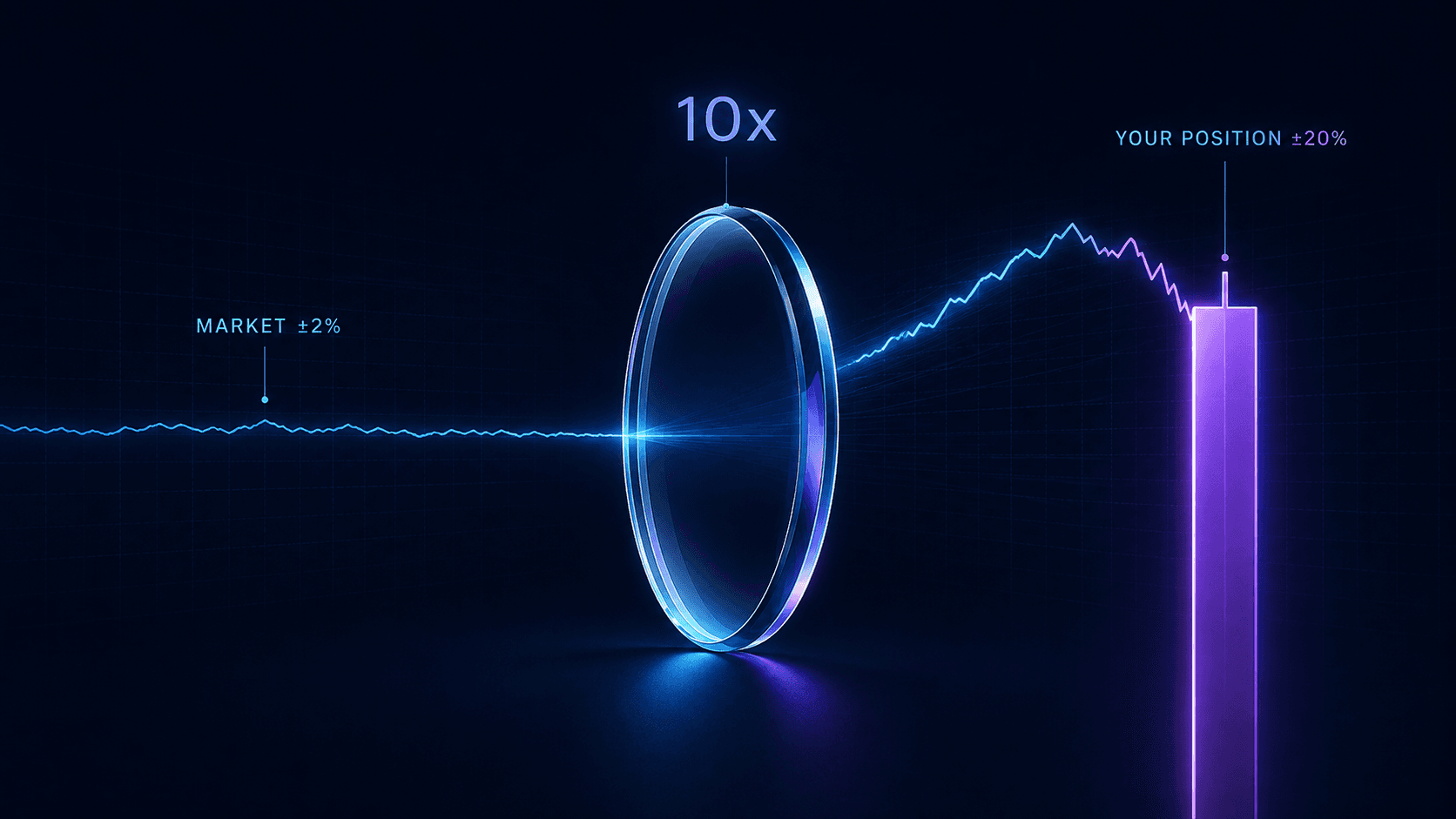
Leverage trading lets you hold a position several times larger than the money you deposited. Put down $1,000 at 10x and you control a $10,000 position, so both gains and losses move ten times faster.
The part most explanations skip is the one that matters: leverage is dangerous not because it multiplies your upside, but because it shrinks your margin for error. At 10x, a 10% move against you erases your entire deposit.
This guide covers the arithmetic, why liquidation arrives earlier than the numbers suggest, what carrying a position actually costs, and how to think about the size question before you open anything.
What leverage actually is
Leverage is temporary buying power extended by the exchange. You post collateral, the platform finances the rest of the position.
Three terms cover the whole mechanism:
- Margin: your own money, set aside to open the position.
- Position size: margin multiplied by leverage. $500 at 20x is a $10,000 position.
- Liquidation: the automatic closure of your position when losses approach your margin.
Leverage does not give you money. It gives you permission to carry a larger position with a smaller cushion. Confusing those two is the most common and most expensive misreading in the category.
How leverage is calculated: a concrete example
Assume Bitcoin trades at $100,000.
Without leverage (spot): $1,000 buys 0.01 BTC. Price falls 10%, you lose $100, your balance is $900. If price recovers later, so do you.
With 10x leverage: $1,000 of margin opens a $10,000 position, or 0.1 BTC. Price falls 10% and the position loses $1,000. That is all of your margin. The position closes, and if price recovers afterwards you are no longer in it.
Same market move. Same direction. Completely different outcome.
The rule of thumb:
Distance to liquidation ≈ 100 / leverage
Leverage and liquidation distance
This table is what leverage is really buying you.
| Leverage | Adverse move that wipes you out | What that is in practice |
|---|---|---|
| 2x | 50% | A severe bear leg |
| 5x | 20% | A bad week |
| 10x | 10% | An ordinary crypto day |
| 20x | 5% | One headline |
| 50x | 2% | An hour of chop |
| 100x | 1% | A ripple in the order book |
These figures are before fees and maintenance margin. Real liquidation always arrives slightly earlier than the table suggests.
Bitcoin moving 5% in a day is unremarkable. Which means 20x leverage makes an ordinary Tuesday capable of closing your position. That is not bad luck. That is the definition of the instrument.
Why liquidation comes earlier than you calculated
Liquidation is the platform force-closing your position at market when losses approach your margin. It exists to protect the platform, not you.
Three things pull it forward:
Maintenance margin. The platform will not let you spend your collateral down to zero. A small percentage of position value, commonly between 0.4% and 1% on major venues, is held in reserve, and hitting that level triggers closure.
Fees are charged on the position, not on your margin. A 0.05% taker fee on a $10,000 position is $5. That is 0.5% of a $1,000 deposit. Opening and closing together take roughly 1% of your margin before the market has done anything at all.
Slippage. In fast moves, a liquidation order fills at whatever price is available, not the price you calculated. In thin liquidity that gap gets ugly.
Net effect: at 10x your real liquidation threshold is closer to 9% than 10%.
Long and short
Leveraged positions work in both directions.
- Long: you profit if price rises.
- Short: you profit if price falls.
The liquidation arithmetic is identical either way. On a short, price rising eats your margin, and upward moves have no theoretical ceiling.
The cost nobody quotes: funding
Most crypto leverage is traded through perpetual contracts, which have no expiry date. To keep the contract price tethered to spot, traders on one side pay traders on the other at regular intervals. That is the funding rate.
It is typically settled every eight hours. In calm markets the baseline sits around 0.01% per interval, roughly 0.03% per day. In heated markets it can run several times higher.
That sounds trivial. It is not, because funding is charged on position size. At 10x, 0.03% per day on the position equals about 0.3% per day on your margin. Hold for a month and a meaningful share of your deposit goes to carrying cost even if your direction was right the whole time.
With leverage, time is not on your side.
Isolated vs cross margin
One setting changes what a liquidation costs you.
Isolated margin ring-fences a fixed amount of collateral to a single position. If it liquidates, you lose that allocation and nothing else. The rest of your balance is untouched.
Cross margin lets your whole account balance back the position. Liquidation comes later because there is more collateral defending it, but when it does come it can take far more with it.
Cross margin looks safer because the liquidation price is further away. For anyone still learning, isolated is usually the more honest choice, because it caps the worst case at a number you chose in advance.
The real failure mode is not the ratio
Leverage itself is not the problem. Accounts that blow up rarely share a leverage number. They share an absence of rules.
The sequence is familiar: position moves against you, the stop is set wide or never set, the position is held because it will "come back", the margin call arrives, and what remains gets deployed at higher leverage to win it back. What did the damage was not the multiplier. It was the emotional decision at every link in that chain.
Three behaviours cut it down:
- Decide the loss before the size. Do not start with how many times leverage you want. Start with the maximum amount you are willing to lose on this trade. The leverage ratio is an output of that number, not an input.
- Set the stop before you open. A stop placed after entry is a stop placed by emotion.
- Know the expected depth of a losing stretch in advance. How far a strategy has historically fallen from a peak tells you more about it than its win rate ever will. We covered how to read a maximum drawdown figure separately.
Algotitan's strategies exist to automate exactly those three decisions. Position size follows a rule, risk limits are defined before execution, and the system does not revise them under pressure. That is not a claim about returns. Losing periods happen and will happen. It means the decision at the hard moment is not made by panic or stubbornness.
You do not have to take that on faith. You can watch a strategy run for 14 days on live market data with virtual funds, with no payment, no card, and no exchange connection. Here is how paper trading works and what it can and cannot tell you.
Trading involves risk of loss, including loss of principal. Paper results are simulated and may differ from live results due to fees, slippage, and liquidity. This is not investment advice.
If you are new, the short version
- Leverage changes your margin for error, not your edge.
- 10x means a 10% move ends the position, and fees make it closer to 9%.
- Funding drains your margin every day you hold.
- Isolated margin caps your worst case. Cross margin does not.
- Spot trading has no liquidation. It is slower, and that is the point.
Nothing about this requires urgency. Opening a leveraged position before you understand the mechanics is the most expensive way to learn them.
Frequently Asked Questions
What is leverage trading in crypto? Leverage trading lets you open a position larger than your deposit by borrowing buying power from the exchange. A $1,000 deposit at 10x controls a $10,000 position. Gains and losses both scale by the same multiple.
What does 10x leverage mean? It means your position is ten times your deposit. In practice, a 10% move against you wipes out your entire margin. Once maintenance margin and fees are included, the real threshold is closer to 9%.
How much can I lose with leverage? On standard perpetual contracts, losses are capped at your margin because liquidation closes the position automatically. In sharp gap moves some platforms can leave a negative balance. Read your platform's specific policy before opening a position.
What is liquidation in crypto trading? Liquidation is the forced closure of your position when losses approach your posted margin. The higher the leverage, the shorter the distance to it: roughly 10% at 10x, roughly 2% at 50x.
What is the funding rate? Funding is a periodic payment between long and short traders on perpetual contracts, typically settled every eight hours. It keeps the contract price near spot. Because it is charged on position size, it costs far more at high leverage.
Is isolated or cross margin safer? Isolated margin limits your loss to the collateral assigned to that position. Cross margin uses your whole balance, which delays liquidation but increases what a single bad position can take. Isolated is usually the safer default while learning.
Can I trade crypto without leverage? Yes. Spot trading means buying the asset outright. There is no liquidation and no funding cost. If price falls your position shrinks, but it does not close.