Futures Trading Bot: How It Works and How to Choose One
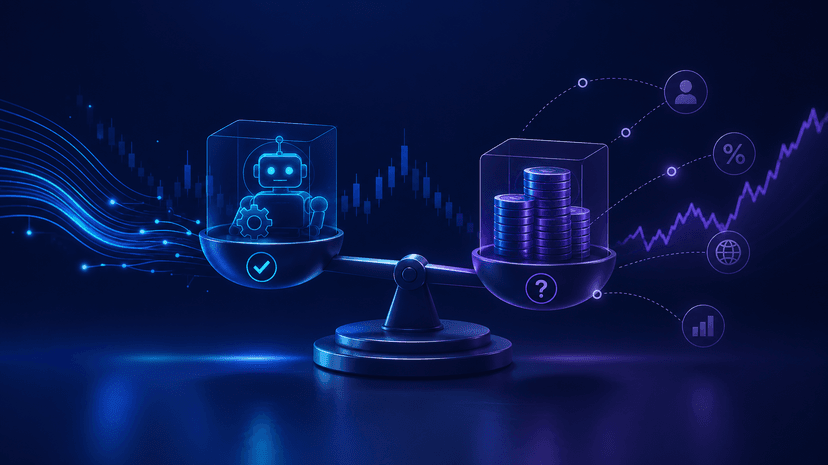
A futures trading bot opens and closes crypto futures positions for you, by rules, through an API key on your exchange account. The right one can trade long and short around the clock without fatigue. The wrong one can move your money off the exchange, or run a leveraged position into liquidation while you sleep.
This guide explains what a futures bot does, what changes compared with a spot bot, and the checks that separate a bot worth connecting from one to avoid.
What is a futures trading bot?
A futures trading bot is a program that opens and closes crypto futures positions on your exchange account by preset rules. It connects through an API key, opens long or short positions, sets position size and exits, and closes trades without manual clicks. Unlike a spot bot, it trades with margin, so its positions can be liquidated if the market moves far enough against them.
On crypto exchanges, the most traded futures are perpetual contracts: futures with no expiry date, settled in USDT and kept close to the spot price by periodic funding payments. If those terms are new, read spot vs futures first.
What changes when a bot trades futures instead of spot
A futures bot is not just a spot bot with a different market selected. Four things change, and each one changes how you should judge the bot.
| Spot bot | Futures bot | |
|---|---|---|
| Direction | Profits only when price rises | Can go long or short, so it can trade falling markets |
| Capital | Uses the full amount it buys | Uses margin; the position can be larger than the money behind it |
| Worst case | The coins lose value | The position is liquidated and its margin is lost |
| Ongoing cost | Trading fees | Trading fees plus funding payments while a position is open |
The practical consequence: a futures bot's risk controls matter more than its entry rules. Position size, leverage and distance to liquidation decide whether a bad week is a drawdown or a wiped margin. Our guides to leverage and liquidity cover the mechanics behind this.
Types of futures trading bots
Futures bots fall into two groups.
Bots you configure. Exchanges and bot platforms offer grid, DCA and signal-based futures bots. You choose the pair, the leverage, the price range and the stop conditions. The tool executes; the strategy, and its risk, are your settings.
Ready-made strategies. Someone else writes and tests the rules; you pick a strategy by its risk level and track record. You do not set leverage or levels yourself; you decide whether the published behaviour suits you. AlgoTitan works this way.
Neither group is better by default. A configurable bot rewards experience; a pre-built strategy depends entirely on how honestly its record is published.
How to choose the best bot for trading futures
"Best" depends on what you can verify before you connect. Use these eight checks, in this order.
- Withdrawals impossible by design. The bot should connect with a trade-only API key that can place and cancel orders but cannot withdraw or transfer. If a service asks for withdrawal rights, stop. See trade-only API keys explained.
- Your funds stay on your exchange. A bot that asks you to deposit into its own wallet is a custody product, not a trading bot.
- A published maximum drawdown, net of fees. This is the deepest peak-to-trough fall in the record. A bot that shows returns but no drawdown has hidden the number you need most. Max drawdown explained shows how to read it.
- Losing months shown, not hidden. A record without red months is either very short or edited.
- A free run on live data first. You should be able to watch the bot trade demo funds on live prices before connecting your exchange. Paper trading explains what that run can and cannot prove.
- Clear handling of leverage and liquidation. You should know whether leverage is fixed by the strategy or set by you, and that every position carries a risk limit.
- Support for your exchange. Check the exact exchange and account type you use, including regional versions.
- You can stop at any time. Stopping should close the bot's positions, and revoking the API key on your exchange should end access immediately.
Red flags and green flags
| Red flag | Green flag |
|---|---|
| Promised monthly returns or "no-loss" claims | Results shown with drawdown and losing periods |
| Asks for withdrawal permission or a deposit | Trade-only key on your own account |
| Only a backtest, no live or paper record | Free paper run on live market data |
| High leverage advertised as a feature | Risk limit on every position |
| No way to revoke access except "contact support" | Revoke the key yourself in one click |
Our list of crypto trading bot scam red flags goes deeper.
Risks a futures bot cannot remove
A well-built bot reduces some risks, such as late entries or missed stops. It cannot remove these:
- Liquidation. Any leveraged position can be liquidated in a fast move. A risk limit makes this less likely; it does not make it impossible.
- Funding. Holding a position across funding times costs or earns money depending on market positioning.
- Slippage in fast markets. In thin or volatile conditions, orders fill at worse prices than planned.
- Exchange-side events. Maintenance, outages or an expired API key stop a bot from trading. Why is my trading bot not trading covers how to tell these apart from a quiet market.
- Strategy risk. Rules that worked in one market regime can underperform in another. That is why the published drawdown is a record of the past, not a limit on the future.
Trading futures involves risk of loss, including loss of principal.
How AlgoTitan's futures strategies work
AlgoTitan runs pre-built strategies on crypto futures through a trade-only API key on your own exchange account. It can place and cancel orders; it cannot withdraw or transfer your funds, and you can revoke access from your exchange at any time.
| Strategy | What it does | Risk level | Max drawdown |
|---|---|---|---|
| Titan | Flagship portfolio that combines independent approaches for different market conditions | Balanced | −10.2% |
| Momentum | Captures strong directional moves across many altcoins | Balanced | −16.1% |
| Flow | Reads market flow and positioning; most positions hedged | Conservative | −10.4% |
Figures are taken from each strategy page on 4 November 2026, net of fees, and update as new data comes in. Past performance does not guarantee future results.
The facts that matter for a futures bot decision:
- Exchanges: Binance, Bybit, Bitget, BingX, OKX, WEEX, Gate.io and KuCoin.
- Minimum trading balance: $1,000 for Titan, Momentum and Flow. This is the amount the strategy trades with, not your whole exchange balance.
- One strategy at a time, with every plan including all strategies. Plans start at $19 per 30 days; see pricing.
- 14-day paper run first: demo funds on live market data, with no card and no exchange connection.
Paper results are simulated and may differ from live results due to fees, slippage and liquidity. This is not investment advice.
Setting up a futures bot on your exchange
Each exchange handles futures permissions differently: some need the futures account opened before the key is created, some require an IP whitelist, and some connect in one click without a key at all. Use the guide for your exchange:
- Binance trading bot: Enable Futures, IP whitelist, Futures wallet
- Bybit trading bot: account type, Read-Write, IP whitelist
- OKX trading bot: one-click connection, account mode
- KuCoin trading bot: one-click connection, trading password
Frequently asked questions
Do futures trading bots work? They do what they are built to do: follow rules without hesitation. Profit is a separate question that comes down to the strategy, its risk controls and market conditions. Read do trading bots actually work for the longer answer.
Are futures trading bots profitable? Some strategies are profitable over some periods, and none is profitable all the time. Judge a bot by its drawdown and losing months as well as its returns, and treat any promise of guaranteed profit as a warning sign.
What is the best bot for trading futures? The one that passes the eight checks above: trade-only access, funds on your exchange, a published drawdown net of fees, visible losing months, a free paper run, clear leverage handling, support for your exchange, and a way to stop at any time.
Can a futures trading bot get liquidated? Yes. Any leveraged futures position can be liquidated if price moves far enough against it. Risk limits on each position make this less likely, not impossible.
Is a futures trading bot safe? Custody and market risk are separate questions. With a trade-only API key, a bot cannot withdraw your funds. Market risk remains: futures trading can lose money, including your principal.
Can I test a futures bot without risking money? Yes. AlgoTitan runs every strategy for 14 days on demo funds against live market data, with no card and no exchange connection.
How much money do I need for a futures trading bot? It depends on the bot. AlgoTitan's minimum trading balance is $1,000 for Titan, Momentum and Flow. Only trade with money you can afford to lose.
Which exchanges support futures bots? Most large exchanges offer futures API access. AlgoTitan connects to Binance, Bybit, Bitget, BingX, OKX, WEEX, Gate.io and KuCoin.
The short version
A futures trading bot trades long and short on margin for you, which makes its risk controls more important than its entry signals. Choose one that cannot withdraw your funds, publishes its maximum drawdown net of fees, shows its losing months and lets you watch it on paper first. Then connect only the amount you can afford to lose.
Backtested and paper results are hypothetical and may differ from live results due to fees, slippage and liquidity. Past performance does not guarantee future results. Trading involves risk of loss, including loss of principal. This is not investment advice.
[Start in paper mode](https://t.me/algotitan_bot?start=1