Can a trading bot steal your crypto?
A trading bot can only do what its API key permits. If the key has withdrawal permission, yes, your funds can be moved out. If the key is trade-only, the bot can open and close positions but cannot withdraw anything, no matter who controls it. The permission settings decide everything, not the bot's promises.
That is the short answer. The longer answer is worth five minutes of your time, because most people who lost money to "trading bots" did not lose it to bad trades. They lost it to permissions they never checked.
The one thing that actually matters: API key permissions
When you connect any bot to an exchange like Binance or Bybit, you do not hand over your login. You generate an API key, a string of characters that grants specific, limited abilities. The exchange asks you to tick boxes when you create it:
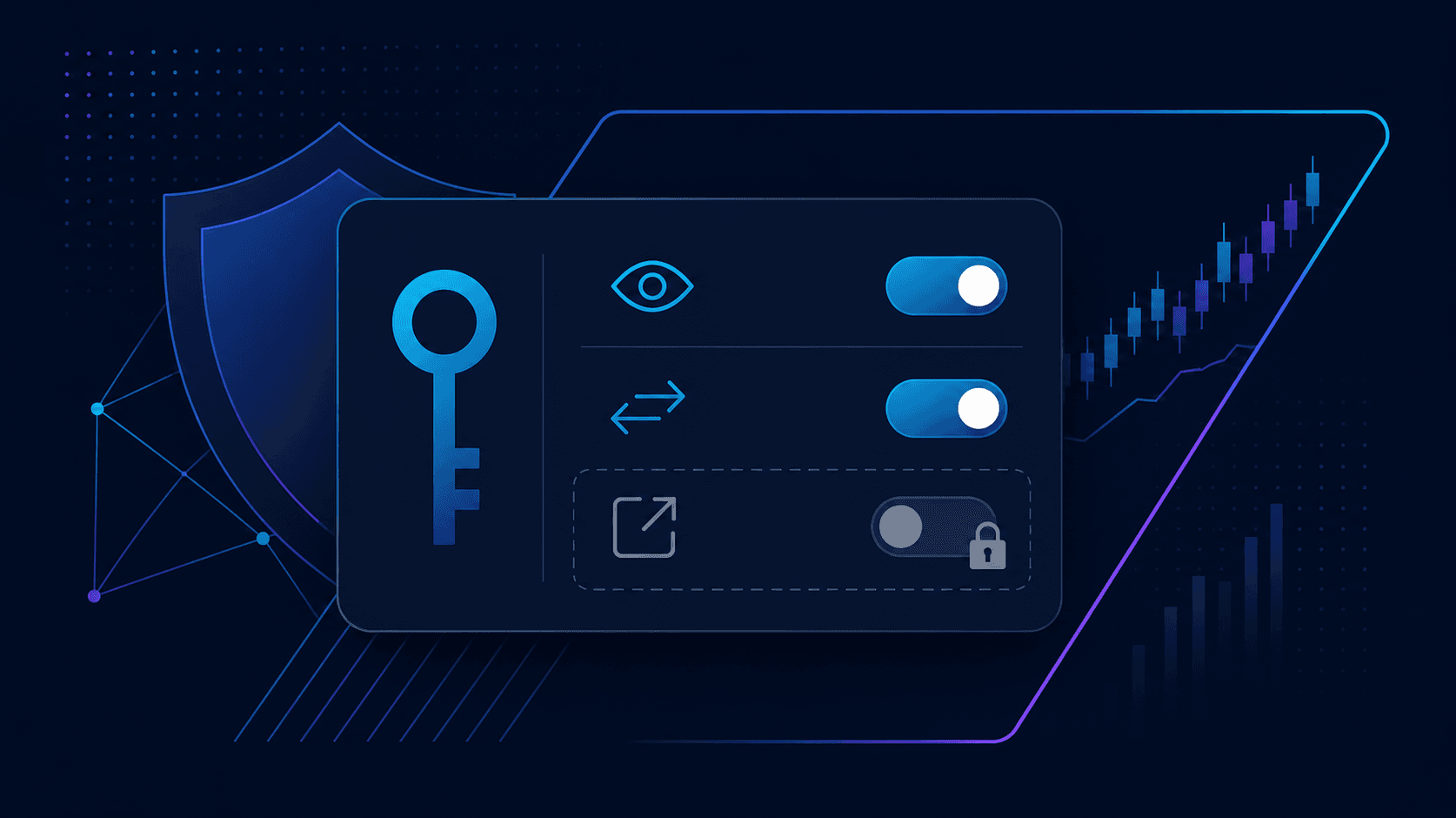
Read - view balances and trade history Trade - place and cancel orders Withdraw - move funds out of the account
These are separate switches. A key with Read and Trade enabled but Withdraw disabled physically cannot move your crypto anywhere. Not to the bot operator, not to a hacker who steals the key, not to anyone. The exchange itself enforces this at the server level. It is not a policy or a promise; it is architecture.
So the honest reframe of "can a trading bot steal my crypto" is: did you give it permission to?
How people actually lose funds to "trading bots"
The scam patterns are consistent, and none of them require sophisticated hacking. Knowing them is most of the protection.
1. The deposit scam
The product asks you to send crypto to them - to their wallet, their platform, their "trading account". This is not a trading bot. It is custody, and usually an exit scam waiting for enough deposits. A legitimate automation tool trades on your exchange account. Your funds never leave it.
2. The withdrawal-permission grab
The setup guide casually tells you to enable all permissions "so the bot works properly". No trading bot needs withdrawal access to trade. There is no technical reason for it, ever. Any product that asks for it has told you what it plans to do.
3. The leaked or phished key
You created a properly restricted key, but pasted it into a fake site, a Telegram DM from "support", or a phishing clone of the real product. Even here, permissions save you: a stolen trade-only key cannot drain your account through withdrawals. The worst realistic damage is malicious trading activity, which is bad but bounded, and why the next section matters.
4. The signal channel dressed as a bot
Some "bots" are just a paid Telegram channel telling you what to buy, sometimes coordinated so early members exit on your entry. No API involved, just manipulated decisions. If the product's core output is "buy this now", it is signals, not automation.
What a trade-only key still allows (honest version)
A trust-first article should not pretend trade-only keys are zero-risk. Here is what a bot with trade permission can still do on your account:
Open and close positions, including bad ones Trade more frequently than you expected, generating fees Take losses within whatever balance is on the account
That means the real risks with a properly configured bot are strategy risk and operator competence, not theft. Trading involves risk of loss, including loss of the funds you allocate. That risk exists with any strategy, automated or manual, and no permission setting removes it.
What the trade-only key removes is the catastrophic scenario: waking up to an empty account because funds were withdrawn. Losses from trading are bounded, visible, and stoppable - you can revoke the key in about two minutes at any time. Theft is neither.
The 2-minute check: audit your API keys right now
If you have ever connected any tool to your exchange, do this today:
- Open your exchange's API Management page (on Binance: Account → API Management; similar path on Bybit, OKX, and others)
- Look at every active key and its permission list
- If any key shows Withdraw enabled and you cannot name exactly why, delete it now
- For keys you keep: confirm only Read and Trade are on
- If your exchange supports IP whitelisting, enable it - the key then only works from the bot's declared servers, making a stolen key useless elsewhere
If you find nothing suspicious, you have lost two minutes. If you find an old key from a product you stopped using in 2024, you may have just closed a door you forgot was open.
Red flags checklist: when to walk away
Walk away from any trading product that:
- Asks you to deposit funds to them instead of trading on your exchange
- Requires or requests withdrawal permission on the API key
- Promises guaranteed returns, fixed daily percentages, or "risk-free" profit
- Hides how it works behind urgency ("limited spots", "closing tonight")
- Has no way to test before paying - no demo, no paper mode, no visible track record you can watch form in real time
- Communicates only through DMs and pressures you to act fast
Any single one of these is enough. You do not need to build a case; you need to close the tab.
Green flags: what a legitimate setup looks like
The inverse list is just as useful:
- Funds stay on your own exchange account at all times
- Connection uses a trade-only API key, and the product says so explicitly and shows you which permissions to enable
- You can watch the strategy run before committing - on live market data, with demo money, before any exchange connection exists at all
- Risk is stated plainly: expected drawdowns, no profit guarantees, clear "you can lose money" language
- You can revoke access yourself, instantly, without asking anyone's permission
This is exactly how Algotitan is built, and it is a deliberate choice: the connection is a trade-only API where withdrawal permission stays disabled, and before you connect anything you get 14 days of paper trading on live market data with demo funds. Paper trading uses virtual money; results are simulated and may differ from live results due to fees, slippage, and liquidity. The point is not that paper results predict profits - they do not, and past performance never guarantees future results. The point is that you see how a strategy actually behaves before a single real dollar is exposed.
FAQ
Can a trading bot withdraw my funds? Only if the API key you created has withdrawal permission enabled. With a trade-only key, withdrawal is blocked by the exchange itself, regardless of what the bot or its operator attempts.
What happens if my API key is stolen? A stolen trade-only key cannot withdraw funds. The attacker could place trades on your account, which is why you should revoke any compromised key immediately and enable IP whitelisting where available.
Is it safe to give a bot my API key? It can be, if the key is restricted to trading only, the product is transparent about permissions, and your funds stay on your own exchange. It is never safe to enable withdrawal permission for a third-party tool.
How do I revoke a bot's access to my exchange? Open your exchange's API Management page and delete the key. Access ends immediately. You do not need the bot operator's cooperation or approval.
Do trading bots guarantee profit? No, and any product claiming otherwise is a red flag. Automated strategies carry risk of loss, including loss of the funds you allocate. This applies to every bot, including well-built ones.